Journal · Pain & Movement
Walking Between a Rock and a Sharp Place
September 10, 2026 · 3 min read
That sharp morning step does not have to be the rest of the season. Sports-medicine acupuncture looks past the heel to the muscle chain that keeps plantar fasciitis from settling — and the research is clearer than “wait it out.”
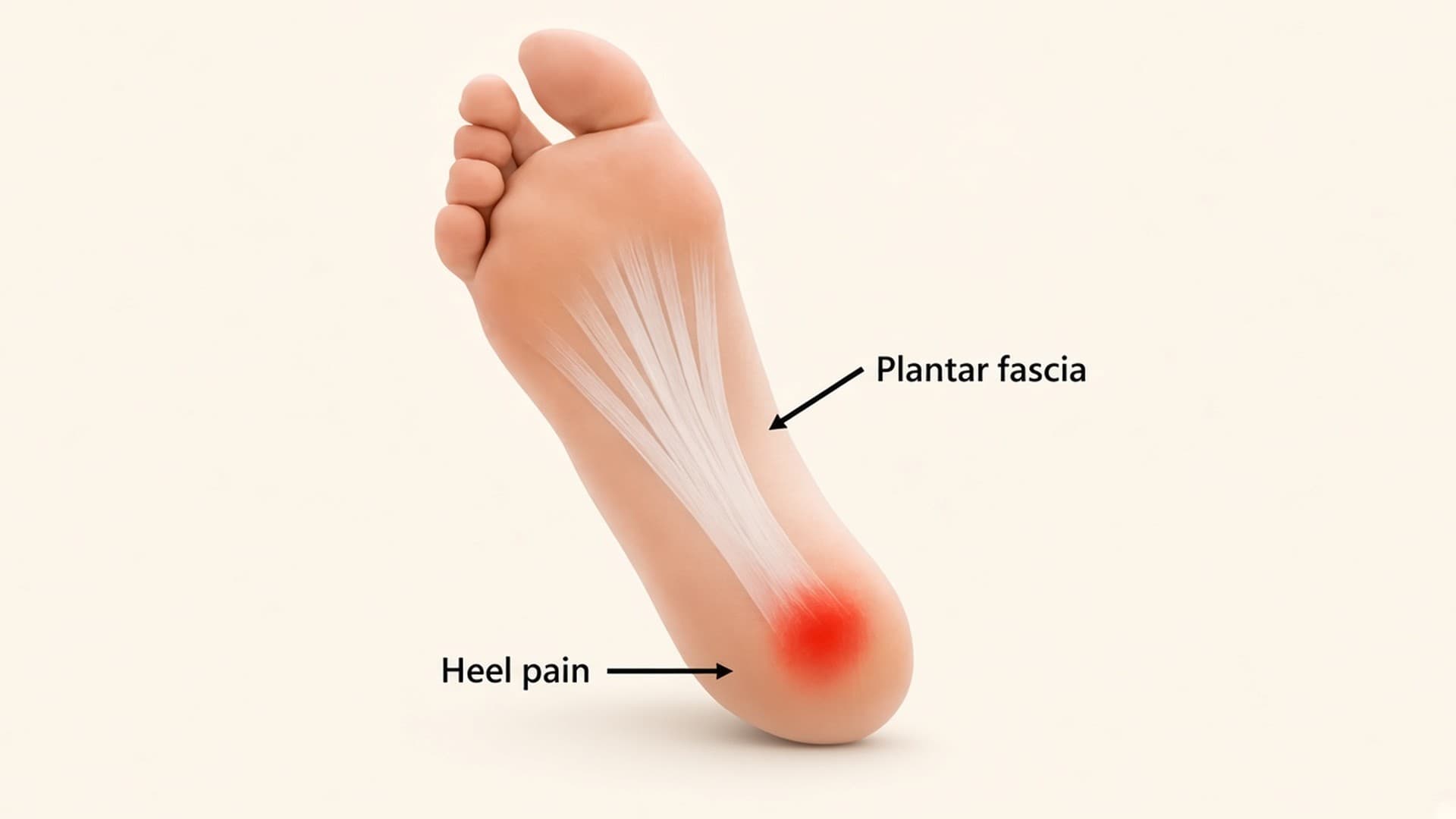
That sharp morning step. The constant ache that ruins long walks, summer concerts, or the run that used to feel effortless. If rest, ice, and stretches are not working, you are likely asking a blunt question: Does plantar fasciitis ever actually go away?
Impatient to get back to an active routine, many people get imaging — an X-ray or MRI — to rule out a stress fracture, nerve entrapment, or a bone spur. When those are clear, conventional care often narrows to calf stretches, foot rolling, orthotics, and towel stretches… together with time and patience.
Home care is already invaluable support, and we want you to keep it. The better news is that acupuncture can help relieve pain in a few sessions when it is provided as a sports-medicine evaluation — not only as needles at the heel.
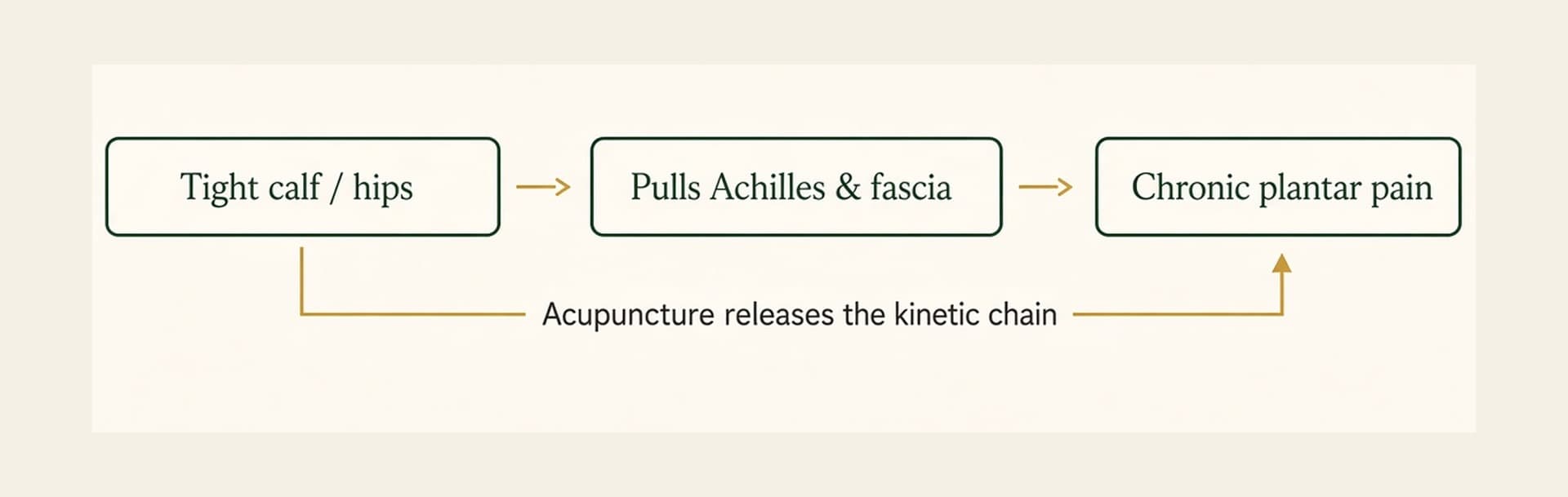
Tight calf / hips
Pulls Achilles & fascia
Chronic plantar pain
Acupuncture releases the kinetic chain
Plantar fasciitis is rarely just a foot problem
An acupuncture evaluation does not focus solely on symptoms. It looks at the environment that created them.
Tight muscle chains extend from the hips and hamstrings down through the calves — specifically the gastrocnemius and soleus — into the Achilles tendon, which meets the multilayered tissue at the bottom of the foot. When that chain is overtight, the plantar fascia acts on the heel like an overtightened bowstring.
Acting only locally can help over time. If you want to speed recovery and rebalance muscles that are not firing properly — inhibited in some places, overactive in others — the whole kinetic chain has to be addressed.
How acupuncture accelerates healing
Acupuncture treats both the localized inflammation and the broader muscular chain. Through target-specific needle placement, it uniquely resets misfiring muscle through neuromodulation: calming overactive calf muscles, stimulating circulation, and signaling the nervous system to release natural pain-relieving endorphins and adenosine.
By releasing tight kinetic chains from the hip down to the heel, acupuncture relieves tension on the plantar fascia, so the tissue can finally heal.
What the research shows
Clinical research supports what patients often feel in practice, with conservative summaries:
- Reduced pain and disability. A systematic review comparing acupuncture with standard care reported significant reductions in pain on both the Visual Analogue Scale and the Plantar Fasciitis Pain/Disability Scale, with noticeable change often within four to eight weeks.
- Hard-to-treat cases. A 2026 randomized trial in chronic, recalcitrant plantar fasciitis found that structured acupuncture outperformed waitlist control. At 16 weeks, the high-intensity acupuncture group reached a 76.7% responder rate (at least a 50% reduction in worst pain), compared with 36.7% in the waitlist group.
A citation is not a guarantee of your outcome. Treatment is individualized, and home care remains part of the plan.
Get back on your feet
Home care is an invaluable help that we support. If waiting months does not feel like enough of an answer when you want your life back, a sports-medicine acupuncture evaluation offers a muscle-chain path to relief — not only modified activity and painful first steps.
Read more about how Ming approaches pain and functional movement, or explore what to expect before a first visit.
Appointments are scheduled by calling Health Link Family Chiropractic in Mechanicsville at 804-559-6818 — Wednesday through Friday — and asking for Ming Acupuncture.
Educational sports-medicine acupuncture note. Not personalized medical advice. Individual responses vary.
This article is for general information and is not a substitute for a medical diagnosis.
Recommended reading
Further study from The Ming Library — curated titles with editorial rationale, not a generic shopping list.
Why Zebras Don't Get Ulcers
Robert M. Sapolsky
Excellent bridge when explaining what Chinese medicine observed experientially and what contemporary physiology can now describe in different language.
Tap the book to view on Amazon
The Body Keeps the Score
Bessel van der Kolk
Used selectively as background rather than making trauma discourse central to Ming’s positioning — embodiment without centering the practice on trauma branding.
Tap the book to view on Amazon
Amazon links are for convenient ordering. We may earn from qualifying purchases.
Explore the full Library